Planned vs Responsive Property Maintenance in Kent and London: Why Your Materials Strategy Needs to Be Different
Property maintenance contractors often deliver two very different types of work: planned maintenance and responsive maintenance.
Both may involve the same operatives, properties and building materials. But from a procurement perspective, they require different approaches. Planned maintenance gives contractors time to forecast demand, agree specifications, schedule deliveries and purchase materials in volume. Responsive maintenance is driven by speed and availability. The requirement may not be known until a repair is reported, an operative attends the property or the true extent of the problem becomes apparent.
Trying to manage both using exactly the same materials strategy can create unnecessary cost, delays and lost productivity. The strongest property maintenance supply chains recognise the difference — and support both.
What Is the Difference Between Planned and Responsive Maintenance?
Planned maintenance is identified and scheduled in advance to maintain, replace or improve property assets. Typical examples include kitchen and bathroom replacement programmes, cyclical decorating, flooring, roofing, door replacement and larger refurbishment programmes.
Responsive maintenance, also commonly called responsive repairs or reactive maintenance, takes place when a fault or repair requirement arises. Examples include leaking pipework, failed toilets, damaged doors or ironmongery, electrical faults, water damage and emergency repairs.
The key procurement difference is predictability.
Planned maintenance allows materials to be organised before work begins. Responsive maintenance requires rapid access to the right products once the requirement becomes known.
Planned Maintenance: Optimise for Predictability
When contractors know that dozens or hundreds of similar properties will be worked on over a defined period, procurement can be planned around expected demand.
Forecast Requirements
Property surveys, agreed specifications and programme schedules can help purchasing teams estimate material requirements before operatives arrive on site.
Better forecasting reduces last-minute purchasing and gives suppliers an opportunity to plan stock around upcoming demand.
Standardise Materials
Planned programmes are particularly suited to material standardisation. Where specifications allow, agreed products can be used repeatedly across multiple properties, simplifying purchasing, stock management, cost forecasting, operative familiarity and future replacement.
Instead of making the same purchasing decision for every property, the decision can be made once and repeated.
Use Volume Purchasing Intelligently
Predictable demand can also create opportunities for bulk purchasing. Frequently required paint, adhesives, fittings, flooring or consumables may be ordered in larger quantities where genuine demand justifies it.
However, volume purchasing should follow the programme. Excessive stock can tie up cash, consume storage space and create waste if requirements change.
Schedule Fulfilment
Planned works allow deliveries to be coordinated with project phases and property batches.
The principle is simple:
Materials should follow the programme rather than the programme waiting for materials.
Responsive Maintenance: Optimise for Availability
Responsive repairs present a different challenge.
Demand is less predictable, the exact product may not be known until the fault is diagnosed, and residents may already be waiting for a repair. Procurement therefore needs to prioritise availability, flexibility and speed.
Keep Core Materials Available
Individual repairs may be unpredictable, but patterns often aren’t. Contractors can identify frequently required plumbing fittings, wastes, valves, sealants, fixings, ironmongery, electrical consumables and repair products and make these readily accessible.
The objective isn’t to stock everything. It’s to make the most likely requirements easy to obtain.
Manage Van Stock
For mobile responsive-repair teams, suitable van stock can help operatives complete more jobs without leaving site to source materials. Too little stock increases collection journeys and return visits. Too much ties up money and creates duplication.
The answer is a controlled core range based on genuine usage, supported by regular replenishment.
Establish Approved Alternatives
Products will occasionally be unavailable or unsuitable for unexpected site conditions. Where contracts and technical specifications permit, identifying approved alternatives in advance can prevent unnecessary delays.
Any substitute must still meet the appropriate application, performance, manufacturer and regulatory requirements. Speed should never replace correct specification.
Prioritise Local Availability
For responsive repairs, the relationship between the job, operative and supplier matters.
A product that’s technically available but requires a lengthy collection journey can still create significant downtime. For contractors operating across Rochester, Medway and Kent, or Peckham and South London, dependable local stock, efficient trade-counter service, Click & Collect and delivery can therefore play an important role.
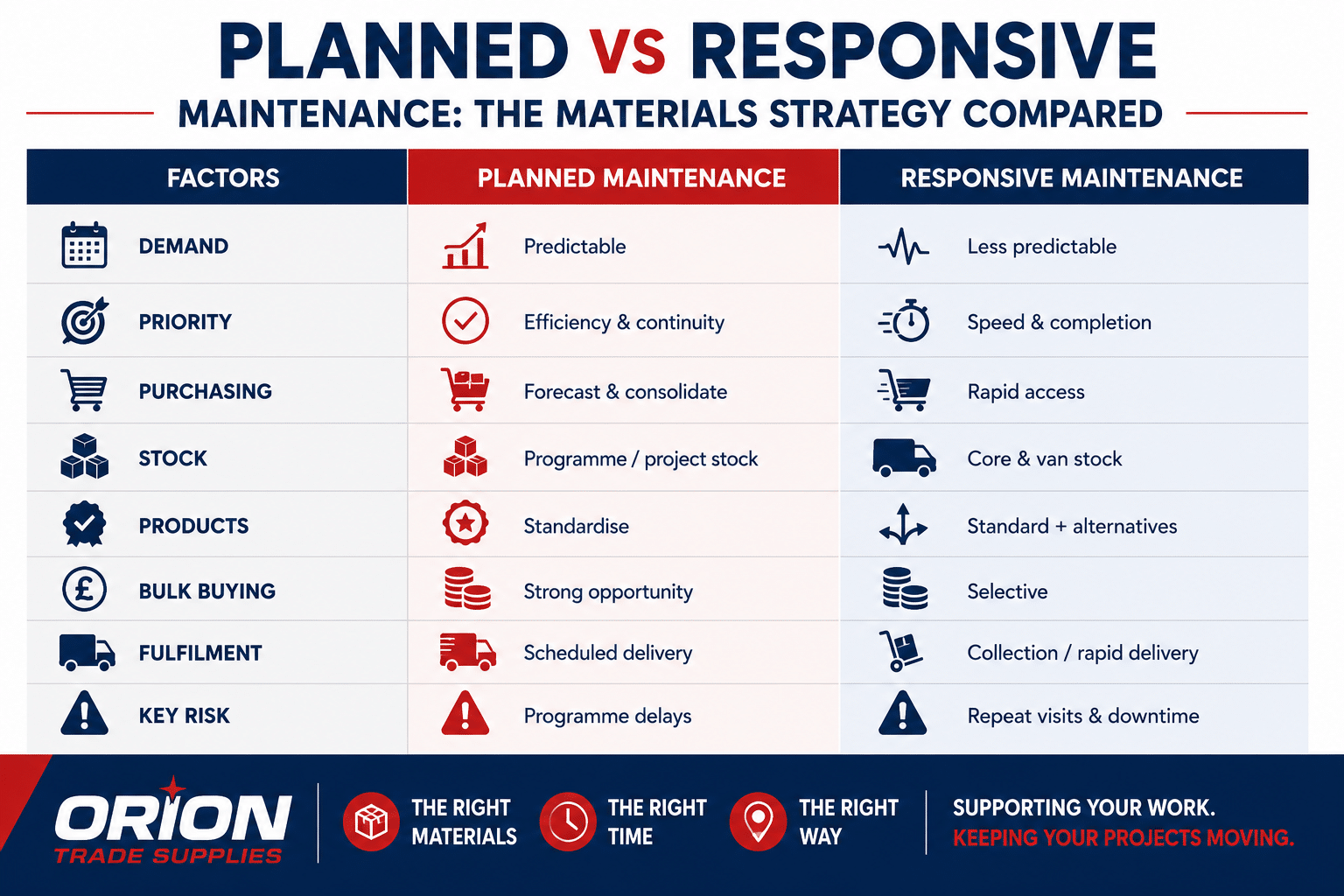
Planned vs Responsive Maintenance: The Materials Strategy Compared
Neither approach is better. They solve different problems.
Where Void Property Refurbishment Fits
Void refurbishment can contain elements of both.
A vacant property can usually be surveyed before work begins, allowing decorating, flooring, kitchen, bathroom, ironmongery and general repair materials to be planned. But additional defects often emerge once work starts.
The materials strategy for social housing void refurbishment therefore benefits from planned procurement combined with the ability to respond quickly when the scope changes. It’s effectively a hybrid model.
Why Materials Availability Matters to First-Time Completion
Responsive maintenance is particularly sensitive to missing materials because a relatively inexpensive component can determine whether a job is completed during the first visit. If the required item isn’t available, the business may face another journey, additional scheduling, more operative time, another resident appointment and disruption to subsequent work.
This is why a material’s true commercial value can’t always be judged by its purchase price. In responsive maintenance, availability has value too.
Good materials planning can’t guarantee first-time completion, but it can remove one common reason for a return visit.
One Contractor May Need Both Strategies
Many property maintenance businesses deliver planned and responsive work simultaneously.
A planned team might operate through Forecast → standard specification → volume order → scheduled delivery while a responsive team requires Diagnosis → immediate availability → rapid collection or delivery → repair.
Trying to force both through exactly the same purchasing process creates friction.
Instead, procurement should identify the products, stock arrangements and fulfilment methods appropriate to each workflow.
What Should the Supply Chain Provide?
A supplier supporting both planned and responsive property maintenance needs to provide more than competitive product prices.
Contractors should consider:
- Breadth of multi-trade materials
- Dependable stock availability
- Support for standard specifications
- Volume purchasing capability
- Appropriate product alternatives
- Scheduled delivery
- Efficient collection options
- Trade Account facilities
- Local availability
- Understanding of maintenance and refurbishment work
The objective isn’t simply to buy building materials. It’s to create a supply arrangement capable of supporting different types of maintenance without introducing unnecessary delays or complexity.
Building the Right Materials Strategy
There is no single procurement model for every property maintenance activity. For planned maintenance, exploit predictability: forecast requirements, standardise appropriate products, consolidate purchasing and schedule fulfilment.
For responsive maintenance, manage uncertainty: identify frequently required products, optimise core and van stock, establish suitable alternatives and prioritise availability. And where a contractor delivers both, build a materials strategy that recognises the difference.
The best procurement process gets the right materials to the right operative in the right way for the work being undertaken.
Supporting Property Maintenance Across Kent and South London
Orion Trade Supplies is an independent, trade-only builders merchant supporting property maintenance contractors, multi-trade contractors, refurbishment businesses, housing providers and facilities management teams.
From
our branches in Rochester, Kent and Peckham, London, we supply
plumbing, bathrooms, kitchens, decorating, flooring, timber, ironmongery, sealants, adhesives, tools and site essentials from our online shop, available for delivery or collection in-branch.
For responsive maintenance, local stock availability,
Click & Collect,
Trade Account purchasing and local delivery can help teams obtain everyday materials quickly. Whether the work is scheduled months ahead or wasn’t known about yesterday:
Materials procurement should support the maintenance programme — not become another obstacle within it.