

A leaking tap, damaged kitchen unit or faulty piece of door furniture might be repairable. But just because something can be repaired doesn’t necessarily mean repairing it is the most cost-effective option.

For contractors managing responsive repairs, void properties and planned maintenance programmes, the better question is:
What will deliver the lowest practical cost over the remaining life of the asset?
That means looking beyond the price of the replacement part.
A £10 component doesn’t necessarily mean a £10 repair. The real cost can include the operative’s time, travel, sourcing materials, gaining access to the property and potentially returning for another visit.
If the repair restores an otherwise serviceable asset for several more years, that’s money well spent.
But if the same component is repeatedly failing, continuing to repair it can become a false economy.
The cheapest repair today isn’t necessarily the lowest-cost maintenance decision.
The condition of the wider asset matters.
Replacing a washer or valve on a relatively modern fitting is very different from repairing the latest fault on something that has already reached the end of its useful life.
Maintenance teams should consider:
Where repeated failures are becoming likely, replacement can provide better value than another temporary fix.
Second and third visits are where apparently inexpensive repairs can become costly.
Each return can mean additional labour, travel, administration and access arrangements. For occupied social housing and managed properties, it can also create unnecessary disruption for residents.
This makes first-time completion and future reliability important parts of the repair-or-replace decision.
A more expensive replacement today may sometimes prevent several additional maintenance interventions later.
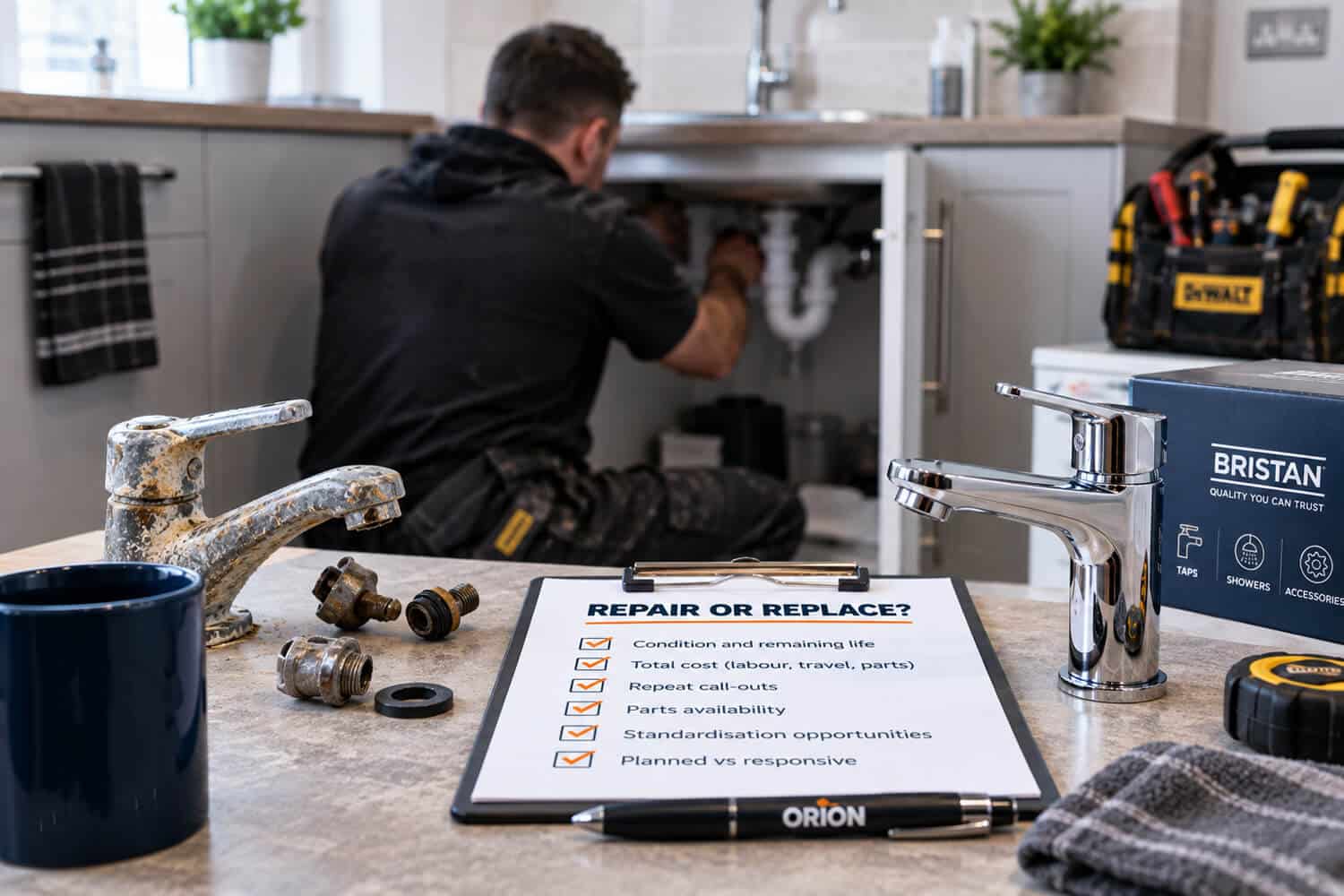
Replacement can also provide an opportunity to bring properties back towards an agreed materials specification. For example, standardising commonly replaced taps, WC components, door furniture or kitchen units can reduce the number of different products and spare parts maintenance teams need to manage.
Operatives become familiar with the products, procurement becomes simpler and suitable replacements can be easier to source.
That doesn’t mean replacing perfectly serviceable items purely for standardisation. But when replacement is already justified, selecting an approved standard product can create longer-term operational benefits.
Repair and replacement don’t always need to happen at the same time.
During a responsive call-out, the immediate priority may be to make something safe or restore service quickly. A temporary or limited repair can therefore be entirely appropriate. The permanent replacement can then be moved into planned maintenance, where materials, labour and access can be organised more efficiently.
This is particularly useful when several similar assets are approaching replacement age across multiple properties.
Void refurbishment creates a different opportunity. With the property unoccupied and trades already on site, replacing a tired component may be more economical than repairing it and risking another call-out shortly after the new resident moves in. Kitchen units, sanitaryware, taps, ironmongery and damaged finishes can all fall into this category.
The decision should still be based on condition and cost — but easy access and the ability to combine work with other refurbishment activity can make replacement considerably more efficient during a void.
Before deciding, ask:
There won’t always be one obvious answer. The objective is not to replace more. Nor is it to repair everything possible.
It’s to make better whole-life maintenance decisions.
For property maintenance contractors, that means balancing materials cost against labour, repeat visits, reliability and future maintenance requirements.
Orion Trade Supplies supplies a wide range of plumbing, bathroom, kitchen, ironmongery, fixings and general maintenance materials for property maintenance and refurbishment contractors, available online for UK delivery and through our trade branches in Rochester, Kent and Peckham, South London.
