

Scale that across dozens of operatives, hundreds of properties and several maintenance contracts, however, and the picture changes.
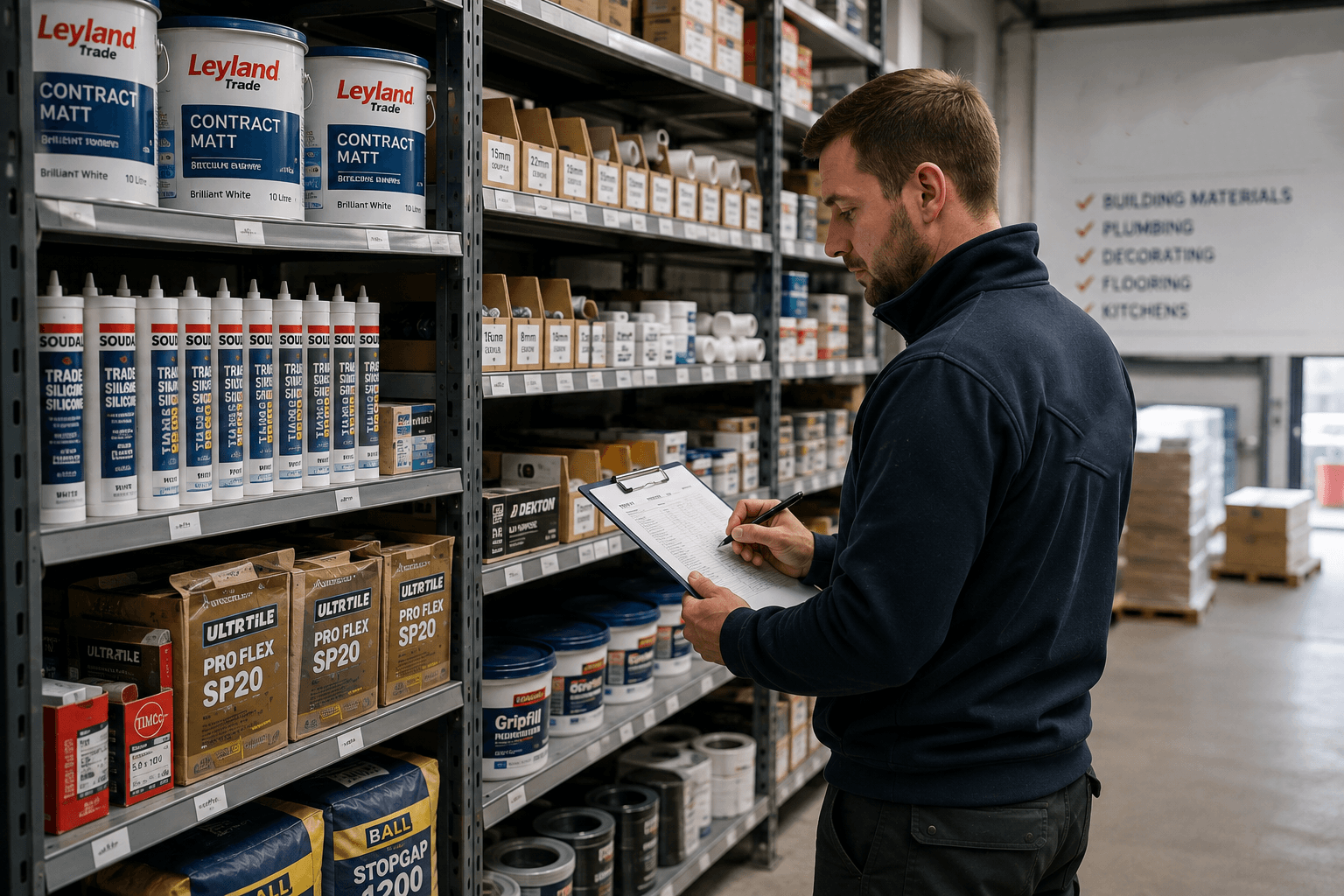
Different paints. Different sealants. Different taps. Different hinges. Different adhesives. Different flooring products.
Before long, the business can be purchasing multiple versions of essentially the same thing. For property maintenance contractors, social housing maintenance teams and facilities management providers, material standardisation can turn an inconsistent purchasing process into a repeatable procurement system.
And the benefits aren’t limited to getting better prices.
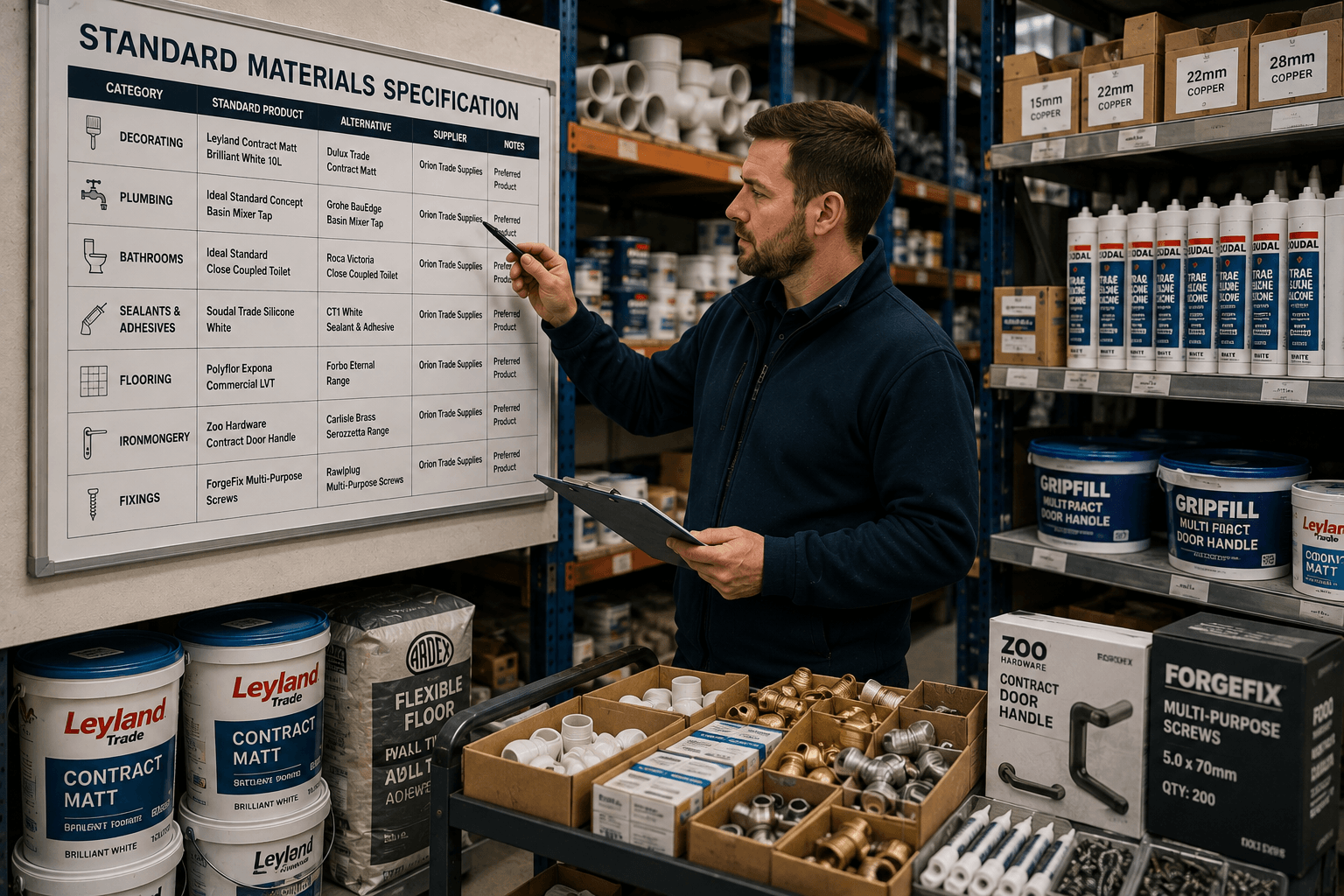
Material standardisation means identifying a preferred range of products for frequently repeated maintenance and refurbishment tasks and using those products consistently wherever the project specification allows.
Instead of an operative deciding which product to purchase every time something is required, the business establishes an agreed specification.
For example:
Decorating
A defined range of contract matt, durable paint, primers, fillers, caulk, brushes and rollers.
Plumbing
Preferred taps, wastes, traps, valves, connectors and commonly used fittings.
Bathrooms
Standard sanitaryware, toilet seats, taps, wastes, shower components and accessories.
Flooring
Defined flooring ranges, adhesives, trims and preparation products.
Kitchens
Standard unit sizes, door ranges, worktops, sinks, taps, handles and associated installation materials.
General maintenance
Preferred silicones, adhesives, fixings, ironmongery, cleaning products and consumables.
The objective isn’t to remove every choice. It’s to eliminate unnecessary choice from repetitive work.
Choice sounds positive. From a procurement perspective, however, excessive variation creates complexity.
If ten operatives are purchasing ten different products to perform the same task, the contractor potentially has to manage:
That makes purchasing, stock management and cost control harder than they need to be.
Standardisation reduces the number of variables.
1. Operatives Become Familiar With the Products
One of the simplest advantages of standardisation is familiarity.
When operatives repeatedly use the same products, they learn:
That knowledge reduces uncertainty. An operative arriving at another property isn’t effectively starting again with an unfamiliar product.
For multi-trade maintenance businesses, this can be particularly useful because operatives may be completing several different types of repair during the same working day.
2. Ordering Becomes Faster
Consider the difference between these two purchasing requests.
“We need some white bathroom silicone.”
and:
“We need another box of our standard white sanitary silicone.”
The second requires far fewer decisions. The product has already been selected. Its suitability has already been established. The supplier already knows what is required. The price is known.
At scale, removing hundreds of small purchasing decisions can make procurement considerably more efficient.
3. Standardisation Supports Better Cost Control
When purchasing is fragmented across many alternative products, understanding the true cost of commonly completed jobs becomes difficult. Standardising the materials used for repeat works creates more predictable material costs.
A contractor can begin to understand that a typical bathroom refurbishment requires approximately a particular basket of products.
The same applies to:
This allows purchasing teams to establish more accurate material allowances and identify unexpected cost increases more quickly.
4. Bulk Purchasing Becomes Much Easier
One of the strongest commercial benefits of standardisation is the opportunity it creates for bulk purchasing. If five different decorating teams use five different paints, purchasing larger quantities becomes difficult. If all five use the same agreed product, demand becomes predictable.
The same principle applies to frequently consumed products such as:
Greater purchasing concentration can make volume pricing more achievable while also reducing the frequency of emergency orders. However, bulk purchasing should always be based on genuine consumption. Buying excessive stock simply because the unit price is attractive can tie up cash and warehouse space.
The objective is predictable purchasing, not unnecessary stockholding.
5. Van Stock Becomes Easier to Manage
Material standardisation doesn’t have to stop at the warehouse. For responsive maintenance teams, it can also help simplify van stock.
Instead of every operative carrying a completely different collection of consumables, contractors can define a core stock list based on frequently completed repairs.
That might include agreed:
The exact specification will depend on the contracts being undertaken, but the principle remains the same.
Standard van stock makes replenishment easier and reduces the likelihood that operatives carry unnecessary duplicates while still missing essential products.
6. Repeat Refurbishment Work Becomes More Predictable
Standardisation becomes particularly valuable where contractors repeatedly complete similar works. Social housing void refurbishment is a good example.
Although every property is different, the underlying work programme often contains familiar elements:
Creating an approved material specification for those recurring activities makes each subsequent property easier to plan.
Instead of rebuilding the materials list from scratch, procurement teams can work from a known baseline and adjust it according to the property’s individual requirements. That makes the purchasing process repeatable without pretending every job is identical.
7. Replacements and Future Maintenance Become Simpler
Standardisation also has benefits after the original work has been completed. Imagine a housing portfolio containing hundreds of different tap designs, toilet seats, door handles or flooring products.
Every subsequent repair requires someone to identify what was originally installed and find an appropriate replacement. Where products have been standardised, replacement becomes considerably easier. The maintenance team already knows the specification. Procurement already knows where it comes from. Operatives may already carry the appropriate replacement.
This can be particularly useful for organisations maintaining large housing portfolios or commercial property estates.
8. It Can Improve Consistency Across Contracts
Property maintenance contractors are often judged not just on whether work has been completed, but on the consistency of that work. Using an agreed material specification helps reduce variation between different operatives and teams.
This can support greater consistency in:
For housing associations, facilities managers and contract managers overseeing large numbers of properties, consistency can be almost as important as initial cost.
No.
Over-standardisation can create its own problems. Different buildings, specifications and client requirements will sometimes demand different products.
There will also be circumstances where:
A good standardisation programme therefore needs approved alternatives. Instead of specifying one product with no flexibility, contractors might establish:
Preferred Product → Approved Alternative → Specialist Exception
That retains procurement control without preventing operatives from responding sensibly to individual jobs.
The easiest way to begin is not by trying to standardise the entire business. Start with the products you buy most frequently.
Identify frequently purchased materials and areas where multiple equivalent products are being bought.
Procurement decisions shouldn’t be made entirely from a spreadsheet. The people using the products every day often understand differences in performance that purchasing data cannot reveal.
Consider:
Stock shortages happen. Make sure suitable alternatives have already been identified rather than forcing operatives to improvise.
Create a simple approved product list that supervisors, purchasing teams and operatives can easily access.
Products change. Prices change. Contracts change. New alternatives become available.
A standard materials specification should therefore be controlled, but never permanently fixed.
Material standardisation becomes even more powerful when combined with a consolidated supplier base. If a contractor knows its preferred products and a principal supplier stocks most of them, procurement becomes dramatically simpler.
Instead of asking:
What product should we use?
then:
Who sells it?
then:
Is it in stock?
then:
What does it cost?
…the purchasing process becomes increasingly repeatable. This is one reason why effective procurement isn’t simply about negotiating lower prices. It’s about removing unnecessary steps from the process.
For contractors completing repeat maintenance and refurbishment work, standardisation can provide a foundation for a much more efficient materials strategy.
It can help businesses:
Combined with supplier consolidation, planned purchasing and dependable fulfilment, it becomes part of a procurement system designed around keeping operatives productive rather than simply buying products cheaply.
For a broader look at these principles, our Complete Procurement Guide for Property Maintenance Contractors explores how material purchasing, supplier relationships, collections, standardisation and job planning can influence the overall cost and productivity of maintenance operations.
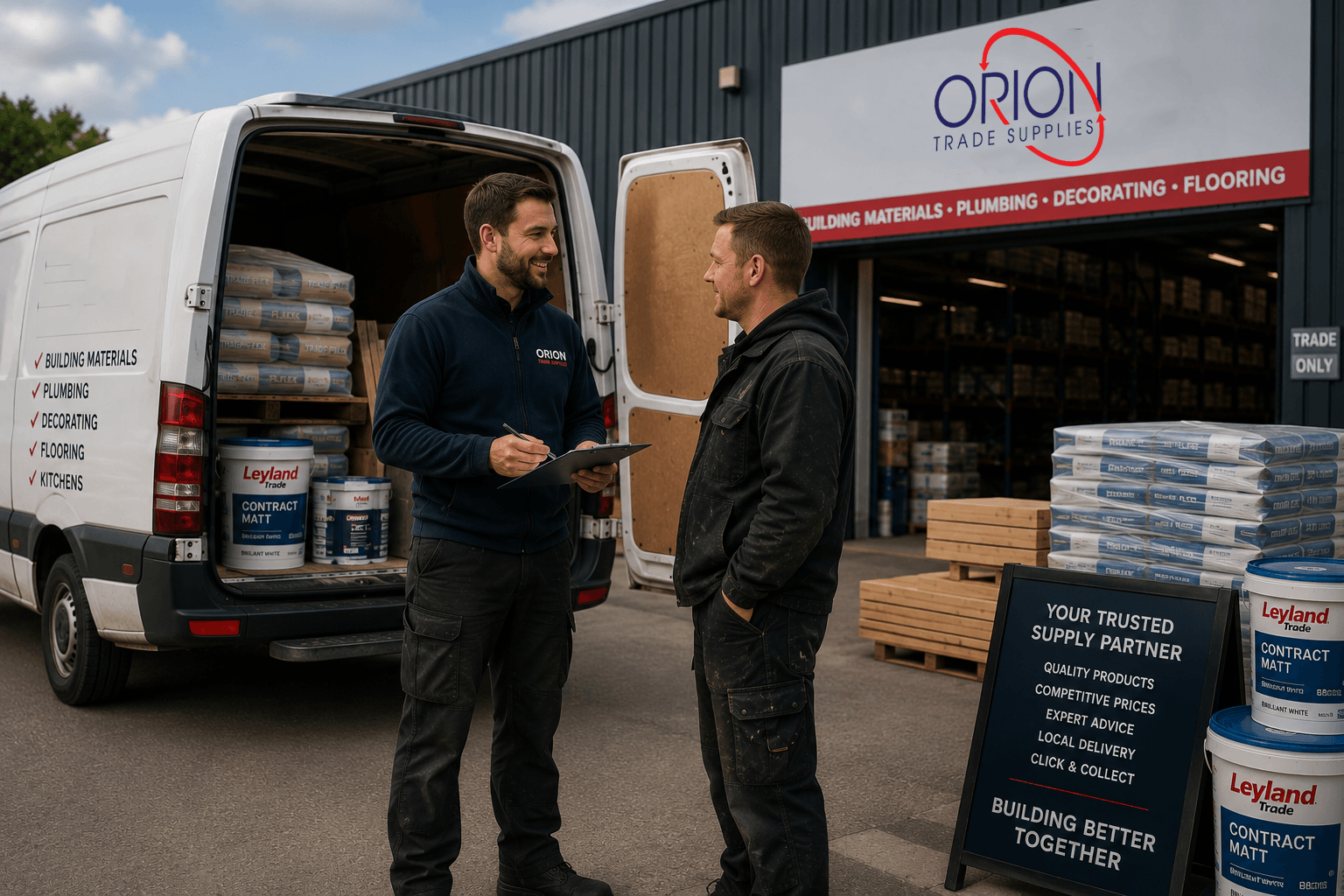
Orion Trade Supplies supports property maintenance contractors, refurbishment businesses, housing providers, facilities management teams and multi-trade professionals from our branches in Rochester, Kent and Peckham, London.
By supplying building materials across multiple trades under one roof, we can help contractors simplify procurement, consolidate frequently purchased products and build more consistent material specifications.
For businesses operating across Rochester, Medway, Kent, Peckham and South London, having dependable access to the products used every day can make repeat maintenance work considerably easier to manage.
Because effective procurement isn’t about creating more purchasing choices.
It’s about making the right choices once — and making them easy to repeat.
